Piedmont Technical College Electric Vehicle Curriculum Team receives A. Wade Martin Innovation Team of the Year Award
In recognition of its impressive accomplishments, the Piedmont Technical College (PTC) Electric Vehicle Curriculum Team received the A. Wade Martin Innovation Team of the Year Award.
The team – consisting of Vice President for Academic Affairs Dr. Keli Fewox, Dean of Engineering and Industrial Technology Christina Knight, Automotive Technology Program Director Gerald Sartin and Automotive Technology Instructor Bill King – was presented with the coveted award Feb. 13 during the South Carolina Technical Education Association annual conference in Myrtle Beach. The award is named after the first executive director of the technical and industrial training program in South Carolina.
Through strategic partnerships, academic innovation, industry alignment and a commitment to student and community safety, PTC’s Electric Vehicle Curriculum Team has created a successful model for EV education.
“Our EV curriculum supports not only PTC’s mission but the goals of the SC Technical College System,” said Fewox, adding that the innovation team award “affirms PTC’s growing leadership role in EV workforce training across the Southeast.”
The process that led to the award began with a realization that South Carolina’s automotive and advanced manufacturing sectors are undergoing rapid transformation as electric vehicle technologies become central to production, diagnostics and service. Technicians entering today’s service bays increasingly encounter high-voltage systems requiring specialized competencies—skills largely absent from most two-year automotive programs.
In response to this shift, PTC’s Electric Vehicle Curriculum Team mounted an ambitious, research-driven initiative that included an academic collaboration with the Clemson University Center for Workforce Development.
“In every aspect of our work together, the Electric Vehicle Curriculum Team has demonstrated the qualities this award seeks to honor - innovation, responsiveness to emerging needs, meaningful collaboration and a strong commitment to workforce and economic development,” stated Dr. Rebecca Short, director of operations at Clemson’s Center for Workforce Development.
The effort also included emerging national-level partnerships with Hyundai, Genesis and Kia that provide access to proprietary EV training systems. 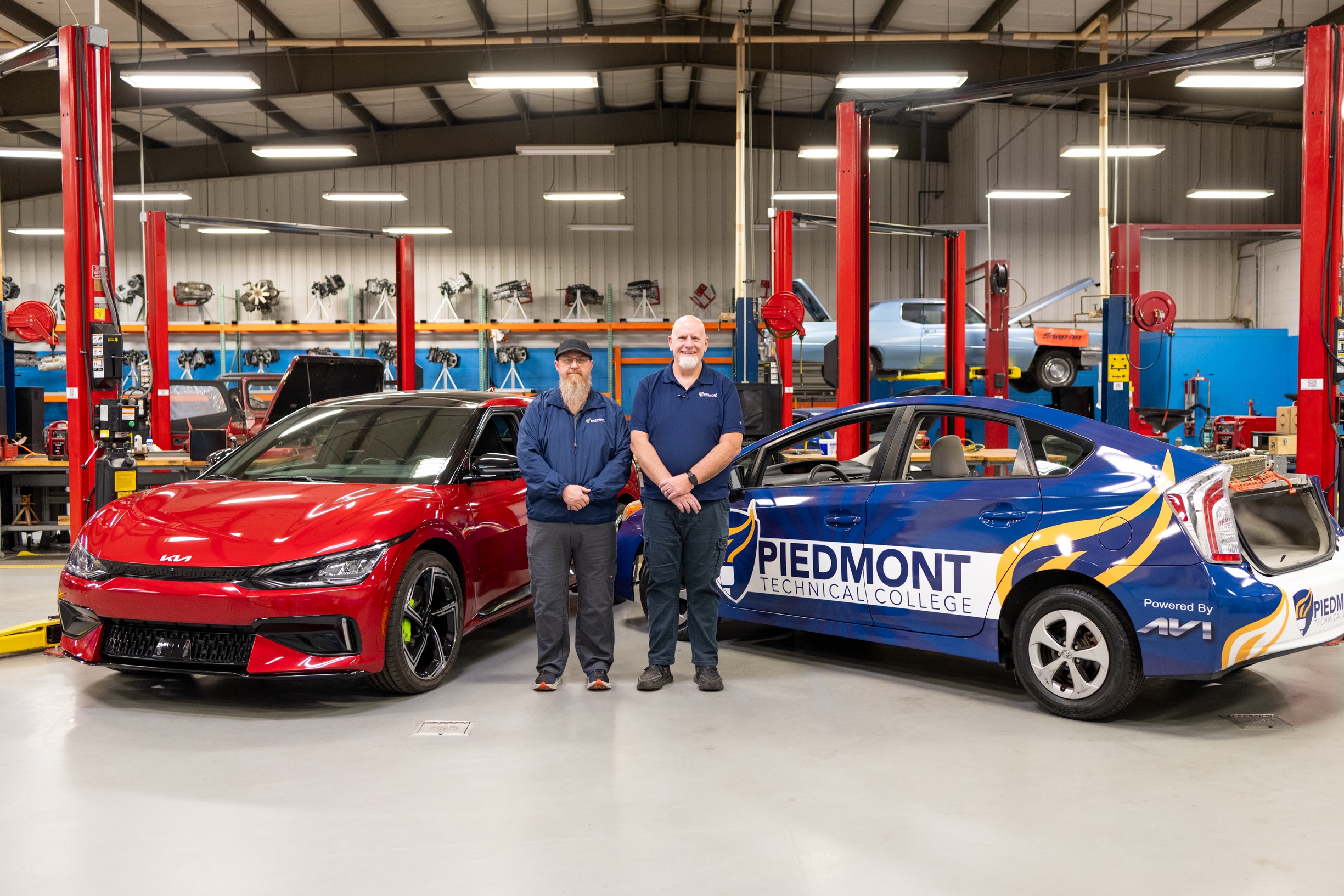
“PTC is only the second college in the nation with which Kia has formed this level of EV training partnership, a testament to our readiness, credibility and demonstrated commitment to innovation,” Knight said.
Kia reinforced its partnership by donating an EV6 for instructional use, significantly expanding PTC’s hands-on EV training capabilities.
The Electric Vehicle Curriculum Team was able to secure a $332,554 National Science Foundation (NSF) Advanced Technological Education grant, enabling PTC to modernize its automotive curriculum and elevate the college’s role in preparing South Carolina’s EV workforce. The grant also funded the purchase of a hybrid cutaway trainer, providing students with an in-depth, visual understanding of high-voltage systems.
In addition to modernizing the for-credit curriculum, the team was aware that local automotive technicians, dealership personnel and independent shop owners require rapid upskilling in EV technology. The team coordinated with PTC’s Workforce Innovation Division to adapt key portions of the high-voltage safety and diagnostics content into non-credit, short-term training opportunities.
“As a representative of the local Kia dealership and a member of PTC’s Automotive Technology Program Advisory Committee, I have had the privilege of watching this team redefine what a modern technician education program can accomplish,” stated Tracey Terrell. “The Electric Vehicle Curriculum Team has delivered an exceptional and highly innovative effort that strengthens technical education and advances South Carolina’s workforce.”
Beyond student learning, the team identified a broader community need.
“Emergency responders are facing new challenges when dealing with high-voltage vehicles in accidents or hazardous situations,” Sartin said.
To address this issue, the team developed an EV First Responder Safety Module designed for firefighters, EMTs, law enforcement personnel and collision repair technicians.
“This initiative elevates both community safety and public confidence while reinforcing PTC’s mission to serve its region comprehensively,” King said.
The team’s work has led to creation of a ready-made blueprint that could be used to modernize automotive technology programs at other technical colleges in South Carolina.
“This work reflects the college’s long-standing commitment to advance communities through industry-responsive education,” said PTC President Dr. Hope E. Rivers. “The team has created a model that prepares students for emerging technologies while advancing South Carolina’s workforce.”